What Are the 7 Conditions of Hijab? A Complete Guide
Most women who wear hijab know it should cover properly. Fewer know there is a specific scholarly framework – seven documented conditions – that defines what “properly” actually means. Understanding what hijab actually means in Islam before diving into the conditions makes everything clearer. This is not about policing wardrobes. It is about giving women the full picture.
Modesty Is a System, Not a Single Rule
Islamic scholars derived these conditions from the Quran, authenticated hadith, and centuries of jurisprudence. The framework was systematized notably by Sheikh Muhammad Nasir al-Din al-Albani, and a detailed scholarly treatment is available on islamqa.info. The framework is not cultural – it is theological. Culture shifts, but the conditions remain consistent across the four major schools of Islamic thought.
One thing I see overlooked constantly: women focus entirely on the headscarf while the rest of the outfit quietly fails two or three of these conditions. The scarf alone does not complete the obligation.
The 7 Conditions You Need to Know
1. Must Cover the Entire Body
The awrah for a woman in front of non-mahram men is the entire body except the face and hands, according to majority opinion. Wrists, ankles, and the full neck must be covered. Women seeking this level of coverage often find full-coverage abaya options the most practical single-garment solution.
2. Must Not Be Transparent
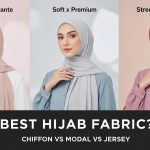
A garment that covers but reveals through thinness technically fails this condition. The Prophet (peace be upon him) warned against women who are “clothed yet naked” – pointing directly at sheer fabrics. Double-layered construction solves the problem immediately. Double-layer chiffon hijabs deliver the elegance of chiffon without the transparency issue that single-layer versions create.
A double-layer chiffon hijab is the easiest way to meet condition 2 without sacrificing style.
3. Must Not Be Skin-Tight
The garment must hang loose enough that body contours are not visible. Fitted abayas, bodycon-cut long dresses, leggings worn as outerwear – all fall short here. Layering with modest tops and layering pieces solves the silhouette problem for everyday outfits.
4. Must Not Be an Adornment
The hijab itself should not draw attention through heavy embellishment or decorative excess. The intent is that the covering should not become the statement. Plain, solid-color hijabs for everyday modesty are the straightforward answer here.
5. Must Not Be Perfumed
Wearing strong fragrance that draws attention of non-mahram men violates this condition, based on authenticated hadith. It does not mean fragrance is forbidden outright – only that application with the effect of attracting non-mahram attention falls outside the framework.
6. Must Not Resemble Men’s Clothing
The Prophet (peace be upon him) cursed those who imitate the opposite gender in dress. The standard here is social context: what reads as masculine dress in your community may differ from another. The principle holds across cultures.
7. Must Not Be a Garment of Fame or Vanity
The thawb al-shuhrah refers to clothing chosen specifically to display wealth or status. Wearing the most expensive designer abaya to signal affluence contradicts the spirit of modesty even if every other condition is met. This is the condition most rarely discussed and probably the most quietly violated in practice.
Where Most Wardrobes Actually Fall Short
Conditions 3 and 4 are where practical gaps appear most often. A properly opaque hijab paired with a form-revealing outfit still fails condition 3. A loose, full-length outfit finished with a heavily embellished hijab fails condition 4. Getting one element right while neglecting the others is the most common pattern.
You could argue applying all seven conditions strictly leaves little room for personal style. Except that logic breaks the moment you see how much variation is possible within the framework – color, fabric texture, draping style, layering – none of which require violating any condition.